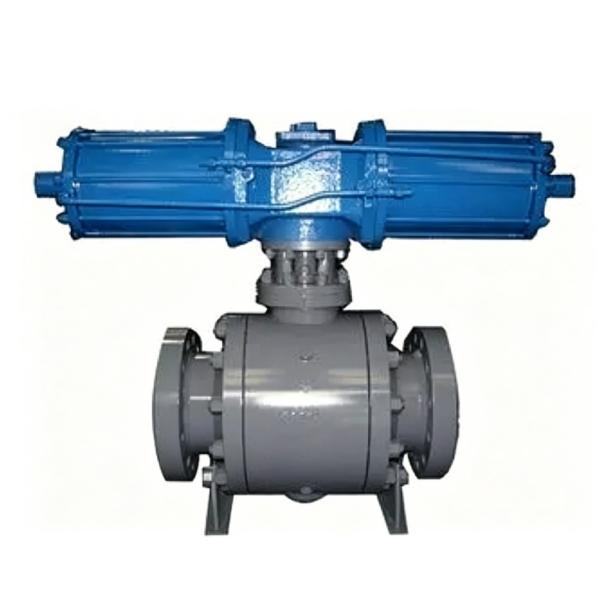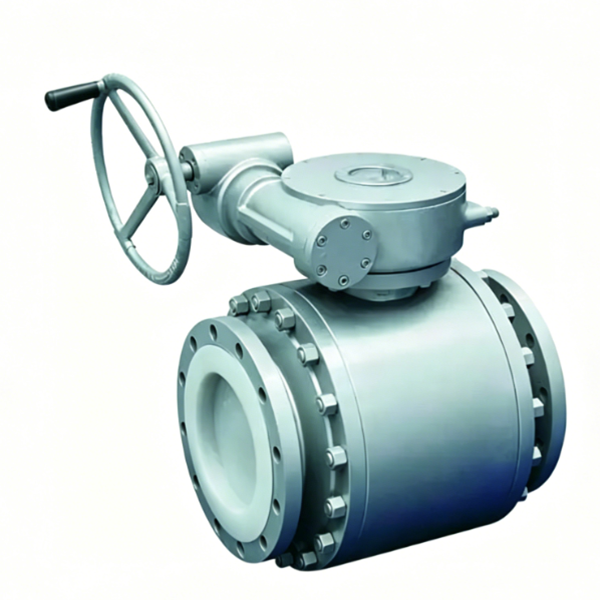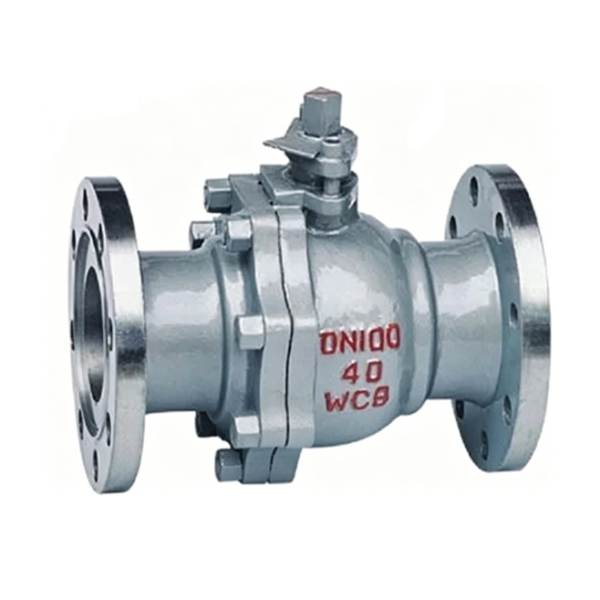
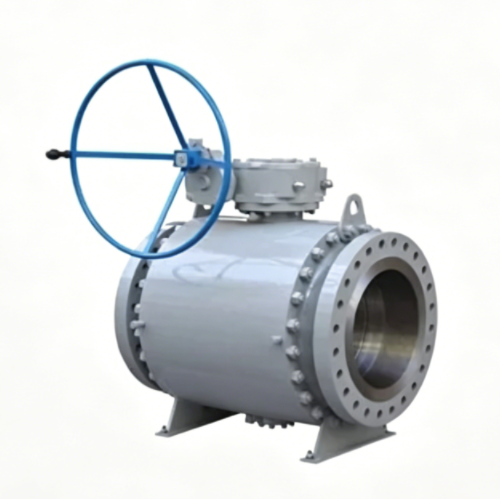
Q341Y flange forged steel ball valve
The material of Q341Y turbine floating hard seal flange forged steel ball valve is forged, and the density of the material is much higher than that of casting. The forged steel ball valve is a type of ball valve that rotates around the center line of the valve body to achieve opening and closing. The sealing element is embedded in the stainless steel valve seat, and the metal valve seat end is equipped with a spring. When the sealing surface wears out or burns out, the spring pushes the valve seat and the ball to form a metal seal. It has a unique automatic pressure relief function. When the pressure of the medium in the valve chamber exceeds the pre tension force of the spring, the outlet valve seat retreats and disengages from the ball, achieving the effect of automatic pressure relief. After pressure relief, the valve seat automatically resets. It is suitable for general working media such as water, solvents, acids, and natural gas, as well as for media with harsh working conditions such as oxygen, hydrogen peroxide, methane, and ethylene. It is widely used in various industries.
1. Characteristics:
The standard valve seat adopts a spring structure, which pushes the valve seat towards the sphere, ensuring good bidirectional sealing performance at the inlet and outlet; By using the built-in discharge valve, the chamber in the valve body can be discharged outward; The pivot adopts an anti blow out protection structure, effectively preventing leakage; Low friction coefficient bearings minimize torque and facilitate valve opening and closing;
The contact between the valve stem and the valve body enhances the performance of the anti-static grounding device.
It has the advantages of excellent performance, high reliability, wide applicability, and reasonable price.
2. Overview:
The valve body is divided into three parts along the section perpendicular to the valve passage axis at the two valve seats. The entire valve is symmetrical left and right along the central axis of the valve stem. The high-pressure forged steel ball valve is mainly used in pipelines to cut off, distribute, and change the direction of medium flow. Its large pivot structure accurately positions the center of the sphere under high pressure, ensuring good operational performance of the valve.
3. Model Description:
Q41F-16/420CQ41N-16C/420CQ41H-16/420CQ41Y-16/420C
4. Main scope of application:
Suitable for industries such as chemical, petroleum, natural gas, metallurgy, as well as long-distance natural gas pipelines containing hydrogen sulfide media, high impurities, and severe corrosion.
5. Performance parameters of national standard forged steel ball valve:
a、 Work pressure: 1.0Mpa-42.0Mpa.
b、 Working temperature: -46+550 ℃.
c、 Drive modes: manual, worm gear, pneumatic, hydraulic, electric, etc.
d、 Connection methods: flange, welding, butt welding, socket welding, etc.
e、 Manufacturing standards: national standard, American standard, etc.
f、 Valve body material: forged steel A105、F11、F22、 Stainless steel 304304L, 316, 316L, etc.
6. Design standards:
Design and manufacturing standards shall be in accordance with GB12237-1989ASMEB16.34, API6D General purpose valve flanges and welded steel ball valves
The structural length shall be in accordance with GB12221ASMEB16.10;
The size of the connection end shall be in accordance with JB/T79, GB9113, HG20592; ASME.B-16.ASMEB16.25;
Inspection and testing shall be conducted in accordance with JB/T9092 and GB/T13927-1992API598; General valve pressure test
Fire protection design in accordance with API607;
7. Please install our company's products according to the following instructions:
a: Remove the protective covers on both sides of the flange end and rinse and clean with the valve fully open.
b: Before installation, the entire machine should be tested according to the specified signal (electric or pneumatic) to prevent vibration from affecting performance during transportation. Only after passing the test can it be installed online (wiring should follow the electric actuator circuit diagram).
C: Before connecting to the pipeline, it is necessary to flush and remove any remaining impurities in the pipeline (which may damage the valve seat and ball).
d: During installation, please do not use the actuator part of the valve as a lifting point to avoid damaging the actuator and accessories.
e: This type of valve should be installed in the horizontal or vertical direction of the pipeline.
f: The pipeline near the installation point should not have any low hanging or external force bearing phenomenon. Pipe supports or supports can be used to eliminate the deviation of the pipeline.
g: After connecting to the pipeline, please cross tighten the flange connection bolts with the specified torque.
8. Customer ordering instructions:
a: Product Name and Model
b: Operation mode (including manual turbine transmission, pneumatic hydraulic electric, etc.)
c: Sealing surface material and hardness
d: Valve body material
e: Pressure
f: Medium used (name, viscosity, particle corrosiveness, toxicity)